Make sure you have read our Getting Started Guide and have created the appKey and appToken for the system you want to integrate with VTEX. For stores hosted on Seller Portal or Admin v4, you can find the Application Keys page by clicking on your profile avatar, marked with the initial of your email, and going to Account Settings > Application Keys.
For a complete backoffice integration, you must use our APIs to send your Products, Prices, and Inventory to VTEX and to receive your Orders from VTEX.
To provide more details about this data flow, this overview is divided into initial setup and the ongoing integration flow.
Initial Setup
To get your integration up and running, you need to complete a few setup steps and then configure the middleware that will handle the ongoing flow. See the steps below.
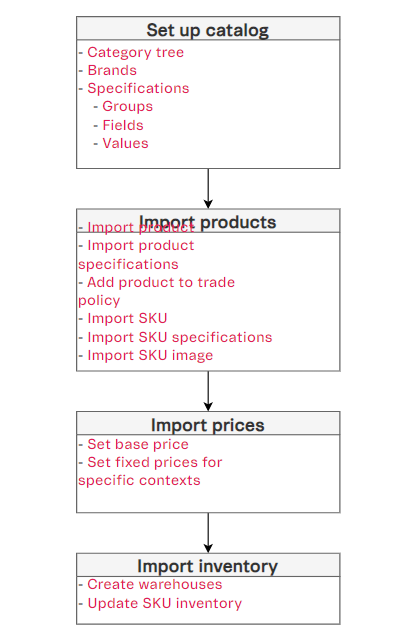
Information about each of these sub-steps can be found in the full documentation available on VTEX’s Developer Portal.
 Note that some of these steps are also used in the ongoing integration. For example, product and inventory registration.
Import Customer Data
When implementing an e-commerce project, you may need to import customer data from other systems, such as Customer Relationship Management (CRM) applications.
Unlike the processes shown in the image above, this import does not require a specific order relative to the other processes.
See the Import Customer Data Integration guide to learn how to carry out this process using Master Data v2.
Middleware Setup
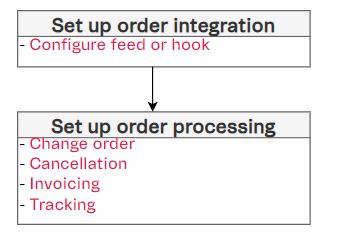
Information about each of these sub-steps can be found in the full documentation available on VTEX’s Developer Portal.
After the initial setup, you must configure your middleware to send and receive information from VTEX based on events in your day-to-day operations.
There are several ways to do this, and your store’s technical team must decide which processes best suit your needs. Solutions can be divided into two main groups:
-
Integration platforms: third-party Platform as a Service companies whose products allow you to build VTEX integrations with minimal development effort.
-
In-house development: if you choose this path, keep in mind that you must not only build the software but also maintain the ongoing integration. For example, the middleware must be able to handle scalability issues that arise from sales spikes, such as those that can occur during a Black Friday event.
Ongoing Middleware Flow
After setting up your store and configuring the middleware, the general flow of information will look something like this:
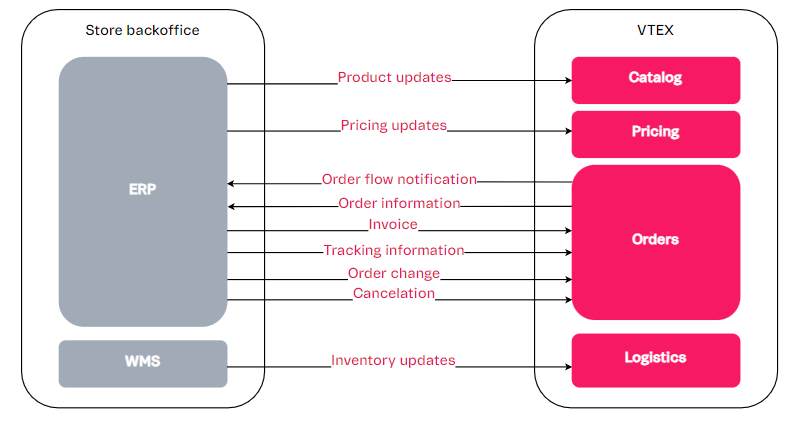
Each of the requests or processes represented by the arrows in the diagram above is triggered by a different event in the daily operation of an e-commerce business.
You can find more details about operations such as:
- Sending product updates
- Sending price updates
- Receiving order flow notifications
- Sending billing information
In our full documentation available on VTEX’s Developer Portal.