A recurring question among our customers, this topic aims to explain why there are two distinct NSU numbers in transactions and how to identify them despite that.
What is the NSU?
NSU stands for “Número Sequencial Único” (Unique Sequential Number). It is a unique reference number assigned to a financial transaction, typically in electronic payment systems such as credit cards, debit cards, or bank transfers. The NSU is used to identify and track a specific transaction, making it easier to resolve issues such as billing disputes or fraudulent transaction investigations. Each transaction is associated with a unique NSU, which can be used by payment processing systems to locate and provide detailed information about that specific transaction.
Why do my transactions in VTEX have two NSU numbers?
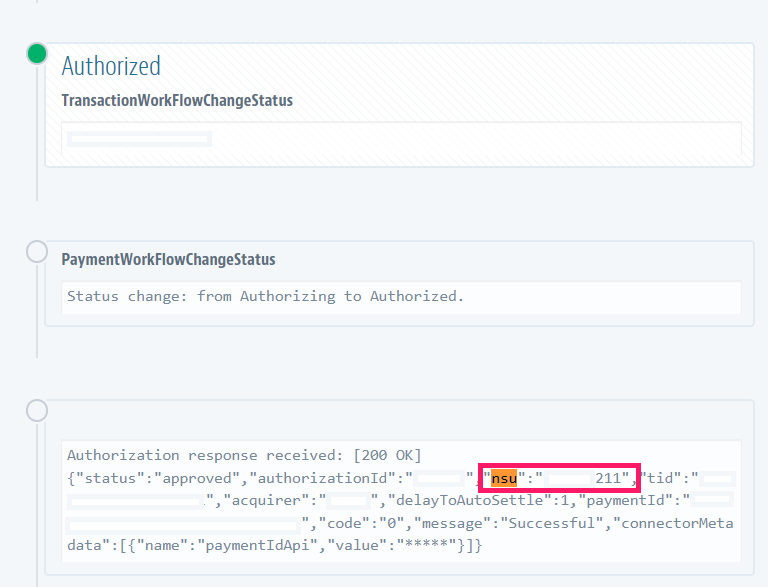
What happens is that for some connectors, transactions have two NSU numbers, each referring to a different stage. This is because we receive from the payment connector one NSU related to the pre-authorization — meaning it appears a few logs before the transaction authorization:
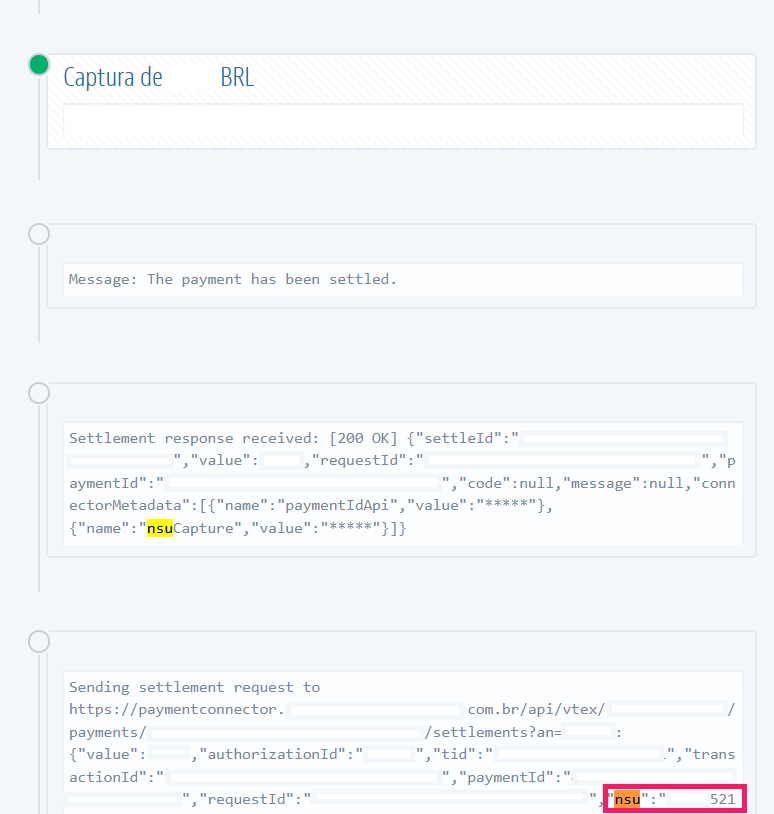
and one NSU related to the capture, which appears a few logs before the payment capture:
How does this transaction flow work?
We have documentation in our HELP center that covers this topic:
Additionally, the image below illustrates how this flow works here at VTEX:

What is the TID?
TID stands for “Transaction ID” in online transactions. It is a unique identifier assigned to each transaction carried out in an electronic payment system, such as purchases made at online stores, bill payments, bank transfers, and more.
The TID is used to track and identify a specific transaction within a payment processing system. It is generally made up of a series of alphanumeric characters that are unique to each transaction, allowing merchants, financial institutions, and payment processors to individually identify and record each transaction. The TID is essential for resolving transaction-related issues such as refunds, disputes, or fraud investigations.
What should be used to identify transactions?
Given the information provided above, the ideal approach is to use the TID to identify transactions. However, if it is necessary to use an NSU to identify a specific transaction, the capture NSU should be used as the reference — this is the second NSU received and will no longer be changed.
If you still have any questions about this topic, feel free to ask here or even open a new thread with your question! 